


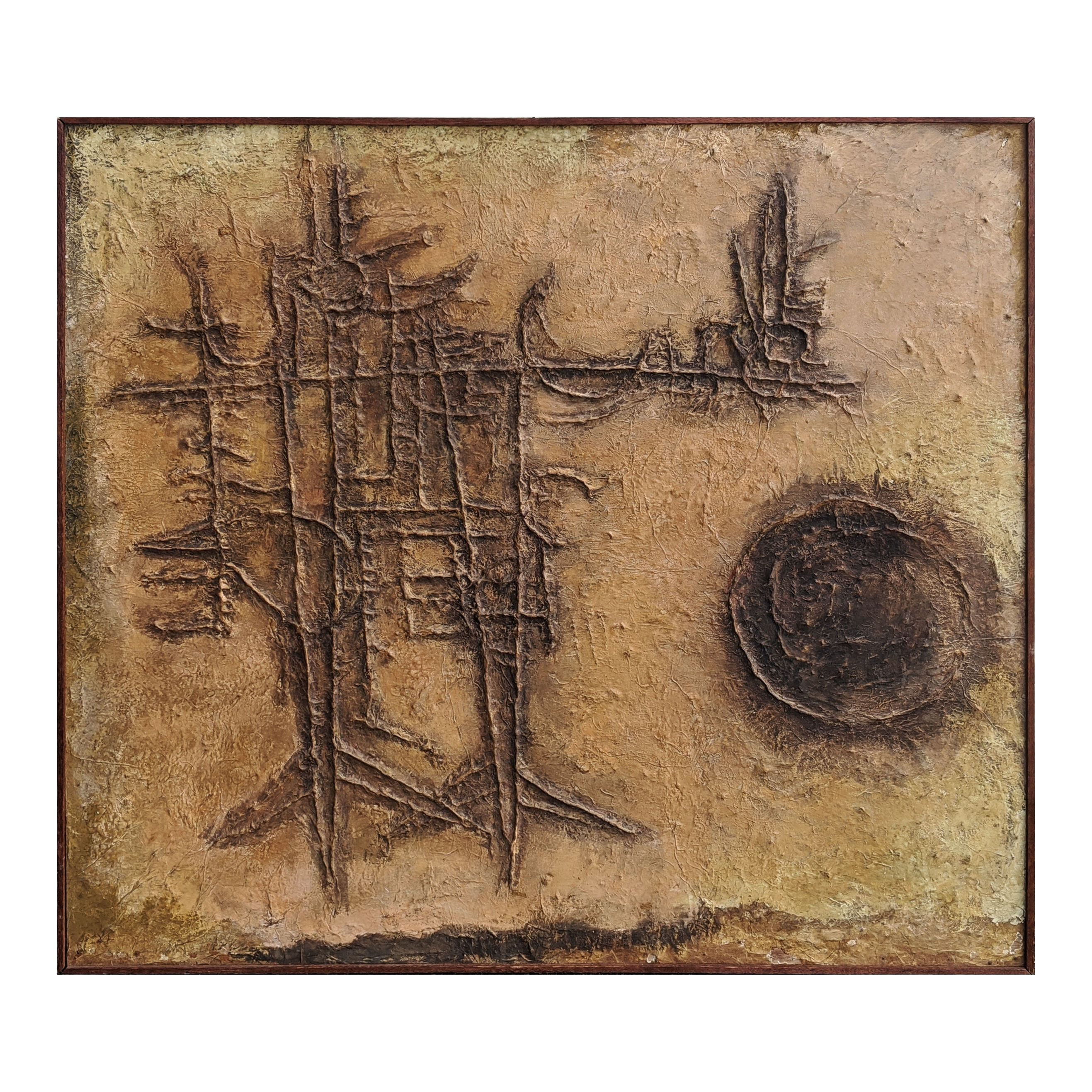
SHIMOMURA, RYONOSUKE (1923-1998)
"Untitled (Bird)" (1958)
mixed media
cm
signed on verso
*James Wynn Collection
*published in Australian Woman's Weekly Magazine, Oct. 1974
Shimomura studied in Kyoto from 1936-43, where he conceived techniques that both alarmed his teachers & saw him awarded the lowest grades in his classes. In 1948, Shimomura saw the first exhibition of the avant-garde nihonga group Pan Real Art Association, formed by Makoto & Takashi. He became a principal member later that year, subsequently giving the organization leadership over decades until his death. Pan Real’s artistic sensibilities were frequently Western, as were Shimomura’s early interests. This is seen in his prewar sketches, influenced by Leonardo da Vinci & Honore Daumier. Postwar, Shimomura pursued fusions of cubism and surrealism. Birds were one of Shimomura’s lifelong loves. In paintings from the later ’50s, he produced less recognizable species of birds than universalized creatures in flight, often with sinister appearance. Shimomura’s stylistic breakthrough came in 1959. He began creating low-relief painting-sculptures made from papier-mache on plywood, over which he painted. The early pieces approximated the appearance of fossilized glyphs surviving a pre-modern culture. The arrival of Shimomura’s relief works, he had created something that was neither specifically nihonga nor yōga, or even painting or sculpture proper. And with these genre-collapsing art works, Shimomura & his Pan Real colleagues began pushing the postwar definitions of nihonga into territory determined more by positional, conceptual & interpretative relations, rather than the earlier essentialist uses of specific painting media, formats and subjects. Shimomura’s work is represented at several important National Galleries & has been the subject of numerous retrospectives, including “Shimomura Ryonosuke: In Praise of Play,” at BB Plaza Museum of Art in Kobe in 2019. This incredible, original work, one of the earliest Abstract Expressionist examples from Japan, comes from important Australian Winemaker James Wynn's collection, & featured in Woman's Weekly in Oct. 1974.